April 10, 2018
Origins of plant photosynthesis illuminated
Photosynthesis, the process by which plants harness sunlight to make their food, is a defining feature of plants and an important evolutionary …
The EARTH archive
Explore the archive by subject.
19 articles · Page 1 of 1
April 10, 2018
Photosynthesis, the process by which plants harness sunlight to make their food, is a defining feature of plants and an important evolutionary …
December 14, 2017
Threats to species can encourage evolution, leading to animals with harder shells or other defensive adaptations. In a recent study in the …
May 17, 2017
Horses have changed size and shape dramatically over the last 20 million years, evolving from small dog-sized creatures with multiple toes into …
February 16, 2017
When kids lose their milk teeth, the roots shrivel up and just the outer enamel falls out — a process known as basal resorption. Now, the …
October 18, 2016
How the turtle got its shell is one of the long-standing conundrums of paleontology. Paleontologists know that one of the first steps toward a …
June 16, 2016
Many insects are social animals. Some, including ants, form colonies with complex social hierarchies, wherein specific roles like reproduction …
April 21, 2016
Evolution is often thought of as occurring over very long timescales, but as a tiny Alaskan fish demonstrates, significant changes can take place …
October 8, 2015
Since the 1970s, the classic “tree of life” taught in classrooms has portrayed three domains of life — Archaea, Bacteria and Eukaryota — all …
October 6, 2015
Dinosaurs dominated the continents during the Mesozoic, and for a long time, paleontologists assumed our mammalian ancestors kept a low-profile …
June 8, 2015
Since first appearing in the fossil record more than 550 million years ago, complex animals have steadily grown in average size, from millimeters …
April 7, 2015
Birds, the only surviving descendants of dinosaurs, have one of the most fascinating — and perplexing — family trees in the animal kingdom. To …
January 5, 2012
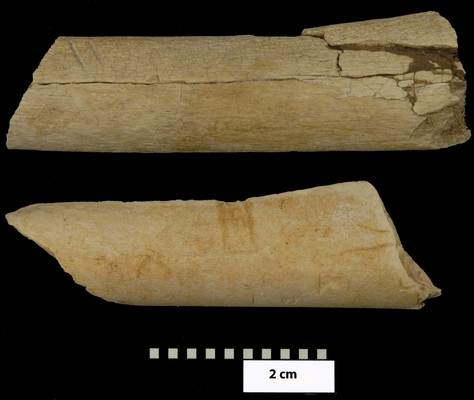
The debate over when our ancestors first used stone tools is not over just yet. In August, researchers had reported finding scratch marks on two …
January 5, 2012
Last October, scientists formally introduced the world to Ardi the Ardipithecus, the well-preserved skeleton of a 4.4-million-year-old hominin …
January 5, 2012
The only monkeys you’ll find on the islands of the Caribbean today were brought there (intentionally or not) by people. But just a few thousand …
January 5, 2012
Did “Clan of the Cave Bear” get it right after all? Probably not, but at least one aspect of the ice age saga is true: Modern humans interbred …
January 5, 2012
Last month, the Smithsonian’s National Museum of Natural History in Washington, D.C., unveiled its new (permanent) human evolution exhibit: the …
January 5, 2012
Millions of years ago, the first animals emerged from their watery habitat to live on dry land. After becoming fully adapted to a terrestrial …
January 5, 2012
The sequencing of the Neanderthal genome in 2010 helps scientists answer the age-old question Calling someone a “Neanderthal” in the heat of an …
January 5, 2012
As celebrations in honor of Charles Darwin’s 200th birthday are in full swing this month, a revolution is rumbling through evolutionary biology. …