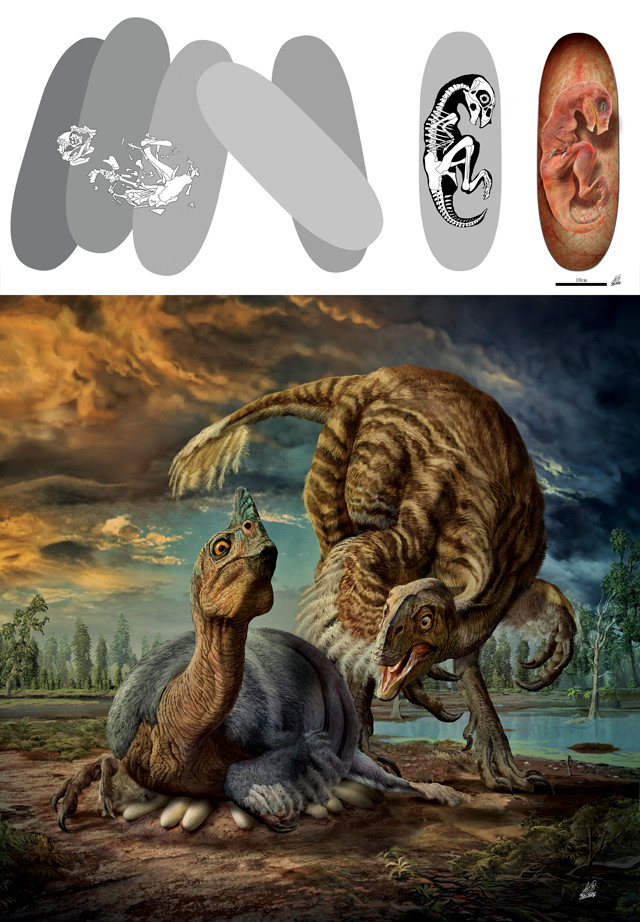
A baby dinosaur found fossilized with a clutch of eggs in China in the 1990s has finally been identified as an embryo from a new species of giant oviraptorosaur, according to a study in Nature Communications. The specimen, nicknamed “Baby Louie” and once featured on the cover of National Geographic, has been formally classified as a caenagnathid oviraptorosaur named Beibeilong sinensis, which translates to “Chinese baby dragon,” by Hanyong Pu of the Henan Geological Museum in Zhengzhou, China, and colleagues.
The 90-million-year-old fossil is only 38 centimeters long, but it hatched from an impressive egg: the largest type ever found, known as Macroelongatoolithus. Macroelongatoolithus eggs are common in North America and Asia, indicating that caenagnathid oviraptorosaurs must have been both widespread and common in the Late Cretaceous. However, the abundance of Macroelongatoolithus eggs contrasts with the confounding absence of giant caenagnathid skeletal remains, which remain elusive.